

Blog
Is Laser Surgery the Right Choice for Kidney Stone Removal?

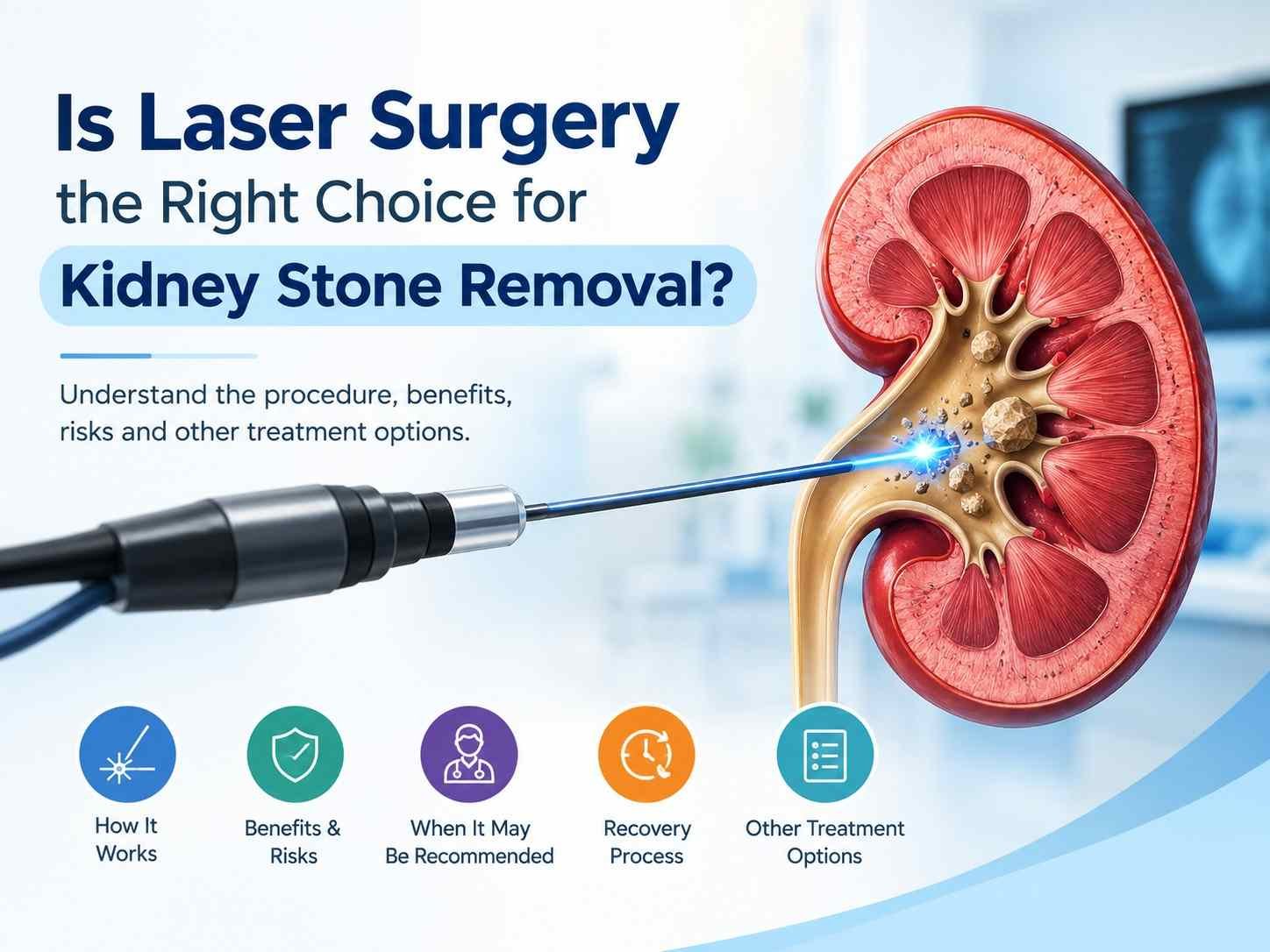
Kidney stones may ruin an otherwise normal day, as you try to figure out what has caused the issue. Laser Treatment for Kidney Stones is one advanced treatment method that is currently in use by doctors in the process of breaking and eliminate kidney stones; however, this is not always the solution for everyone. There are different factors to be considered when determining the best kidney stone laser treatment method.
What Is Laser Treatment for Kidney Stones?
Laser therapy is often combined with a medical procedure known as ureteroscopy. As part of ureteroscopy, a long tube goes into the body via the urinary tract up to the ureter or the kidney, where the urologist locates the stone and destroys it with a laser. In this way, the stone becomes fragmented, and it is either removed using special tools or passes on its own.
When May Laser Surgery Be Considered?
Not all stones require surgical removal. Some small stones can pass out on their own, especially if there is no obstruction or other complications due to the stone. Some stones will be observed by doctors while pain and other symptoms are being controlled.
The need for active intervention arises when the stone gives rise to persistent symptoms, obstruction, infection, bleeding, issues related to the kidneys, stone growth, and other clinical indications.
The size and site of the stone are considerations that also need to be considered. A stone located in the kidney would require a different method from that in the ureter.
How Doctors Decide on Kidney Stone Removal
Here is an easy-to-follow route of decision-making:
Kidney stone identified
↓
Size & Location + Symptoms evaluated
↓
No complications? → No treatment or conservative management possible
↓
Stone removal required?
↓
Evaluation of ureteroscopy, SWL or other method
↓
Lasering is done during ureteroscopy if required
That is the reason why looking for one “best” treatment could be confusing. Each case has its own “best” procedure.
What Happens During Laser Stone Removal?
In laser treatment for kidney stones, it typically requires a urologist to insert a ureteroscope into the urinary tract to find the stone. The stone can then be broken up by using laser energy.
Some of the fragments will be removed using a basket while others can just pass out in urine. A ureteral stent might also be inserted temporarily depending on the condition of the patient.
This treatment is usually done under anaesthesia and the technique, time taken, need for stent insertion, and recovery time all differ among patients.
According to the Patient Information from Cambridge University Hospitals, it is also noted that ureteroscopic stone fragmentation uses a laser and in some cases, a temporary stent might be required after the procedure.
Laser Treatment Compared With Other Options
Laser surgery is only one part of modern kidney stone removal treatment. Doctors may also consider shock wave lithotripsy (SWL) or percutaneous nephrolithotomy (PCNL), depending on the stone.
Treatment approach | How it works | When it may be considered |
Ureteroscopy with laser | Scope reaches the stone and laser fragments it | Selected kidney or ureteral stones |
Shock wave lithotripsy | External shock waves break the stone | Selected stones based on size and location |
PCNL | Small access through the back allows stone removal | Often considered for larger renal stones |
Observation | Stone is monitored while it may pass naturally | Selected small, uncomplicated stones |
What About a 5 mm Kidney Stone?
However, a 5 mm kidney stone does not necessarily mean that surgery will be required, as many other clinical considerations, such as location of the stone, must also be considered.
For a detailed discussion from a patient’s perspective, refer to "Is a 5 mm Kidney Stone Dangerous? Symptoms, Risks, and Treatment Explained".
Kidney Stone Laser Treatment and Recovery
Recovery following kidney stone removal through laser differs from person to person. Some have transient discomfort during urination, blood in the urine or discomfort due to ureteral stent.
Follow-up is necessary depending on your procedure. It may include checking if there are stone fragments left and if the urinary tract has fully recovered.
Warning Signs That Need Medical Attention
Signs of kidney stones can involve severe side or back pain, pain that is felt as it radiates to the lower abdomen or groin, blood in the urine, and nausea and vomiting. Signs of fever and chills can be especially worrisome since they might be signs of an infection.
Choosing the Right Stone Treatment With a Urologist
There is no one-size-fits-all approach to decide if the laser treatment is correct. The things that a urologist might consider include:
- Size of the stone
- Location of the stone
- No. of stones
- Urinary obstruction
- Infection
- Symptoms and pain
- Functioning of kidneys
- Prior treatments for kidney stones
- General well-being and medical history
If you are looking for Laser Surgery for Kidney Stones, then you can locate HOK Super Speciality Hospital via Google My Business listing and seek proper medical advice from them.
At the same time, you should remember not to confuse kidney stones with gallstones. Both are conditions that target different organs and need to be treated differently. If you are in need of Gall Bladder treatment in Delhi, you should seek help from a specialist.
A Practical Take on Laser Stone Removal
In addition to the development of laser technology, ureteroscopy has become an essential technique in modern urology that enables the direct access to stones and their fragmentation by means of laser energy.
Not all cases require the use of lasers, since there are those that can be passed spontaneously or even better treated with either SWL or PCNL. The best decision is determined by the characteristics of the stone and the patient’s clinical state.
If your doctor recommended Laser Treatment for Kidney Stones, find out about the size and localization of the stone, procedure, possibility of stent placement, post-procedural instructions, and alternative treatment options. Adequate treatment begins with adequate knowledge, not with assumptions made based only on the size of the stone.
Ready to Discuss Your Kidney Stone Treatment?
Pain from kidney stones that does not go away, urinary blockages, and recurring kidney stones must be evaluated by a medical professional. Visit us at HOK Super Speciality Hospital for a consultation with a skilled urologist.

About HOK Super Speciality Hospital Team
The HOK Super Speciality Hospital Team is the official medical editorial team of HOK Super Speciality Hospital, dedicated to creating accurate, evidence-based, and patient-friendly health content. Our articles are written and medically reviewed by experienced urologists, surgeons, and healthcare professionals specializing in kidney care, urology, prostate health, urinary disorders, and minimally invasive treatments. Every blog is developed using current medical research, established clinical guidelines, and the expertise of our specialists to ensure readers receive reliable, up-to-date, and easy-to-understand health information. Our editorial process focuses on accuracy, transparency, and patient education, helping individuals make informed decisions about their health. With a commitment to clinical excellence and compassionate care, the HOK Super Speciality Hospital Team strives to promote awareness, preventive healthcare, and trusted medical knowledge. Through our educational content, we aim to empower patients and their families with practical information that supports better health outcomes and overall well-being.
View all posts by HOK Super Speciality Hospital Team